Posts

Showing posts with the label OSINT

Cyber Threat Intelligence for Autodidacts

Image
Introduction Cyber Threat Intelligence (CTI) analysts come from diverse backgrounds, and their roles can vary a lot depending on the type of organisation they work for. The path to becoming a CTI analyst can follow one of several routes, such as moving from Security Operations Center (SOC) and other information security roles, joining from university, or from law enforcement or military backgrounds. I’ve also met many who have radically changed trades and reskilled from jobs such as secondary school teachers to bar and hotel staff with great success. CTI teams can also vary significantly in their structure and focus. Some analysts work for vendors, providing intelligence to multiple clients across industries like, for example, Recorded Future’s Insikt Group. Others serve as defenders within a single company, working to protect that organization’s assets like, for example Equinix’s ETAC team. There are analysts who operate within government agencies as well, such as intelligence, se...

The Ransomware Tool Matrix

Image
Introduction Ransomware attacks are becoming increasingly damaging, but one thing remains consistent: the tools these cybercriminals rely on. The Ransomware Tool Matrix is a comprehensive resource that sheds light on the tactics, techniques, and procedures (TTPs) commonly used by ransomware and extortionist gangs. This repository provides defenders with actionable intelligence on the tools frequently leveraged by adversaries, thanks to the insights shared publicly by the US Cybersecurity and Infrastructure Security Agency (CISA)'s #StopRansomware advisories and The DFIR Report's publications, among others. This repository offers straightforward insights from compiled open source intelligence (OSINT) research that can be directly applied to threat hunting, detection engineering, and incident response operations. Project Background As defenders, we can turn the tables by exploiting a crucial flaw committed by ransomware gangs: tool reuse. Many ransomware gangs repeatedly rely on ...

Tracking Adversaries: Akira, another descendent of Conti

Image
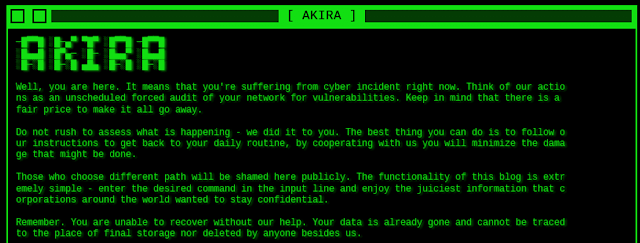
The dozens of cybercriminals that made up the Conti group continue to launch campaigns unabated. Previously in 2022, I blogged about how following the Conti Leaks , the operators of Conti  continued on via multiple rebranded ransomware campaigns, such as Royal, BlackBasta, and Quantum, among others.  Since my last two blogs on the Conti/TrickBot gang, multiple members have been officially sanctioned by the US and UK government in February 2023 and September 2023 , formally confirming attribution to Russia-based threat actors. The sanctions are a vital step in the right direction and helps the public and law makers understand what organized cybercrime looks like and the scale of the fight on our hands. In this blog, however, I wanted to explore the ransomware campaign called Akira that appeared in March 2023  and focus on how Akira is connected to Conti. Akira is a rapidly growing threat to civil society and critical infrastructure and is the ransomware group I believe r...

Investigating SMS phishing text messages from scratch

Image
Online and at conferences, people ask me how to get started in threat intel. What I usually offer as advice to budding analysts starting out is to practise analysing things in the wild. And by 'analysing things in the wild' I mean looking for live reports of cybercriminal activity by others online. One of my favourite examples is SMS phishing text messages, also called Smishing scams.  It is a commonly held view that new analysts learn best by doing. It also does not matter if you are not the first to report on something. New analysts should not worry about that, as long as they do a bit of OSINT at least to confirm they do not accidentally say they are the first and only researcher to find whatever it is they found.  In my experience, there are always organizations and teams with more experience and telemetry than you. It's just that they did not report on it publicly (yet). This goes for even the top research teams at incident response or antivirus companies. Not "be...